Turtle Balance Stepping Stones: Games and Setup Tips
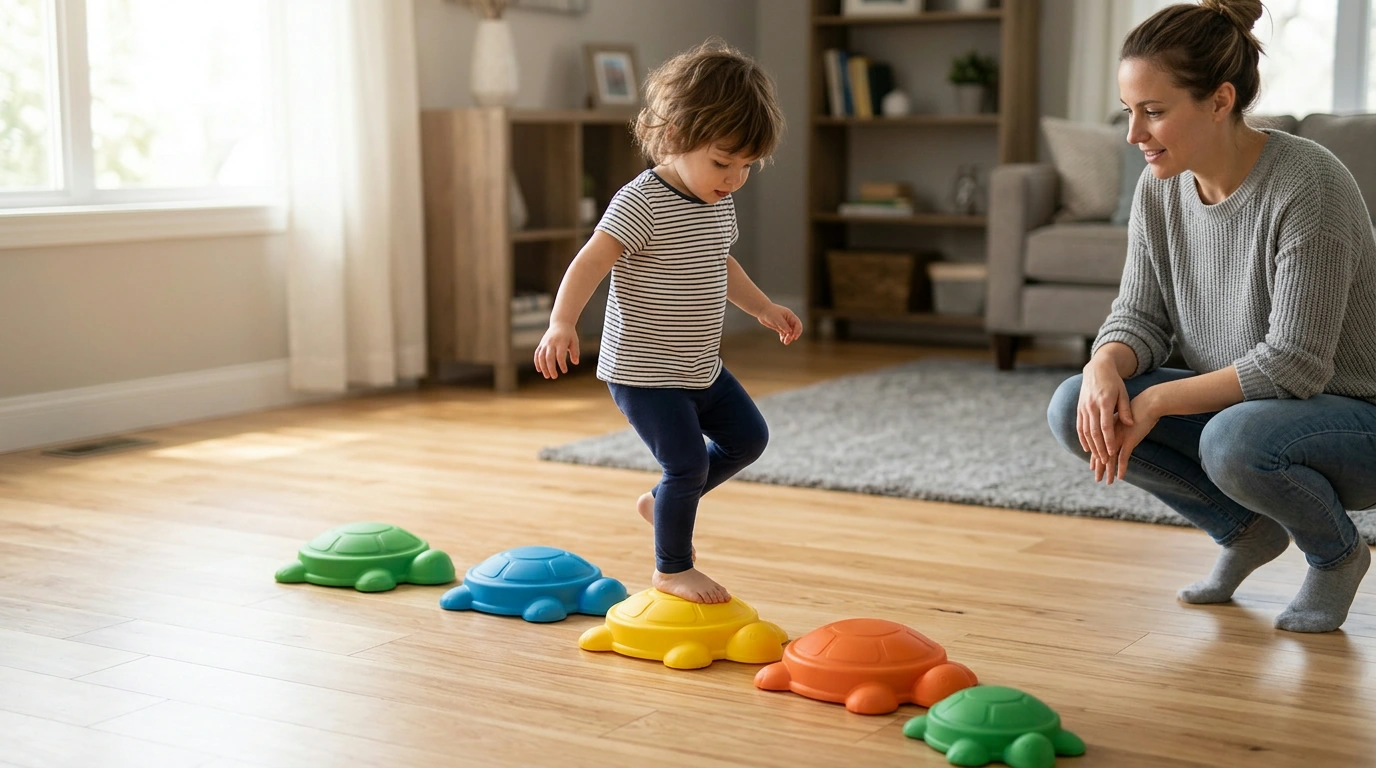
A few turtle-shaped stepping stones can turn an open patch of floor into a winding trail, a set of pretend islands, or a route your child helps invent. Our six-piece set gives you room to rearrange the path without making the rules complicated. Start with comfortable steps, stay close, and let the game change when your child is ready.
Meet the Turtle Stepping Stones
Our 6-piece turtle balance stepping stones are a flexible starting point for movement games. Put them in a line for a first try, or use all six to make a trail with a turn or two. The turtles give each stop a playful name: “Can you reach the next island?” often feels more inviting than “Take another step.”
The set has a non-slip design intended to help provide grip, but that does not mean a stone cannot move. Placement, footwear, the condition of the play surface, and supervision all matter. Before anyone steps on the route, an adult should make sure each stone sits securely. Begin with a short path and nearby stones; save wider spacing for a time when the current route feels comfortable.
Set Up a Route That Fits Your Space
Choose a clear, level area away from sharp furniture edges, loose objects, and other obstacles. Leave room beside the trail so a child can step down without landing on a toy or bumping into furniture. After placing the stones, check each one for movement. Check again whenever you rearrange them; a route that was secure in one layout needs another look in the next.
A straight line makes the first trip easy to understand. Keep the gaps comfortable for your child’s stride, and invite them to walk rather than rush. Once they know the route, move one or two stones to form a gentle curve. A small loop offers another choice: which way should the turtle trail go today? If a gap calls for a jump that feels too big, have your child step down while you bring the stones closer.
| Layout | How to play | Easy variation |
|---|---|---|
| Straight path | Step from one turtle to the next at a comfortable pace. | Pause briefly on each stone. |
| Curving trail | Follow a gently turning route without rushing. | Call out the next stone before stepping. |
| Small loop | Travel around the loop and return to the start. | Change direction for the next turn. |
These are ideas to adapt, not fixed difficulty levels. Your child can also help choose where the next turtle goes while an adult handles the final stability check. That small bit of ownership can make resetting the trail part of the game.
Make Coordination Practice Feel Like Play
Visit the turtle islands
Give every stone an island name and ask your child to travel between them with controlled steps. They might pause to “spot a fish” from one island or wave to you from another. There is no need to cross the whole route without stepping down. A reset can simply begin a new trip.
Follow simple directions
Try calling “forward,” “turn,” or “pause” as your child moves. Give one direction at a time and allow plenty of time to respond. You can swap roles, too: your child calls the directions while you point out which turtle comes next. The aim is to make movement, balance, and planning enjoyable to practice—not to promise a particular result from playing.
With more than one child, let each take a turn designing a route instead of racing across it. Keep space between players, with just one child on a stone at a time. While one child walks the trail, the other can be the island-namer or direction-caller. That way, waiting for a turn still feels like participating.
Keep Play Comfortable and Supervised
Active adult supervision matters throughout play, not just during setup. Before use, inspect the stones and the surrounding area. If a stone slips, shifts, or appears damaged, stop the game and address it before continuing. When the layout changes, walk around it once more to check clearances and confirm that every stone is secure.
Stepping-stone games are one option for adding movement to the day, not a substitute for every other kind of active play. For broader context, the CDC’s guidance on physical activity for children discusses the value of making movement a regular part of daily life.
Bring the Turtle Trail Home
Start with one straight, easy route and play a round together. Then ask your child what should happen next: should the trail bend, become a loop, or lead to a new imaginary island? Our featured 6-Piece Kids Turtle Balance Stepping Stones with Non-Slip Design for Coordination Games give you six stops to work with and plenty of ways to change the story.
If you like to sketch activity ideas before playtime, an adult workspace such as our electric height adjustable standing desk can be a separate spot for planning. Keep furniture out of the play area itself so the turtle trail has clear space around it.
FAQ
How can beginners use the turtle stepping stones?
Begin with a straight route and small, comfortable gaps. Let your child step at their own pace while an adult supervises and checks that the stones remain secure.
Can the six stones be used for different games?
Yes. Rearrange them into a line, curve, or loop, then add simple prompts such as pausing on a turtle or changing direction.
Does a non-slip design mean the stones cannot move?
No. Check the play surface and each stone’s stability before play, and stop to adjust the setup if anything shifts.






Leave a comment